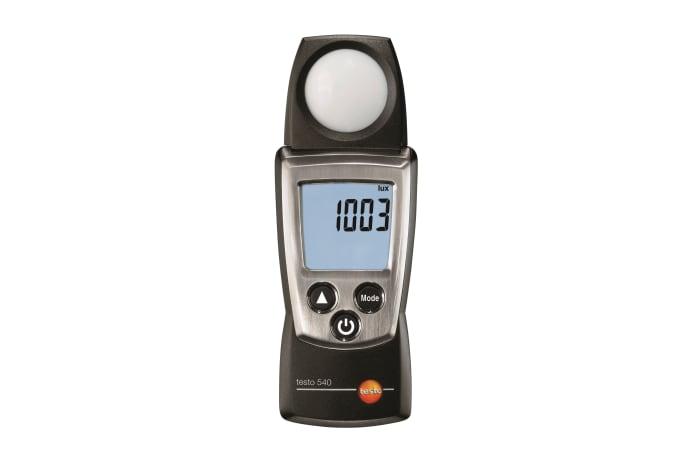
testo 540
0560 0540
EAN:
4029547008283
1.515,00 kr.
/ Piece excl. VAT
OutOfStock
1.893,75 kr. Incl. VAT
🟡 In stock soon
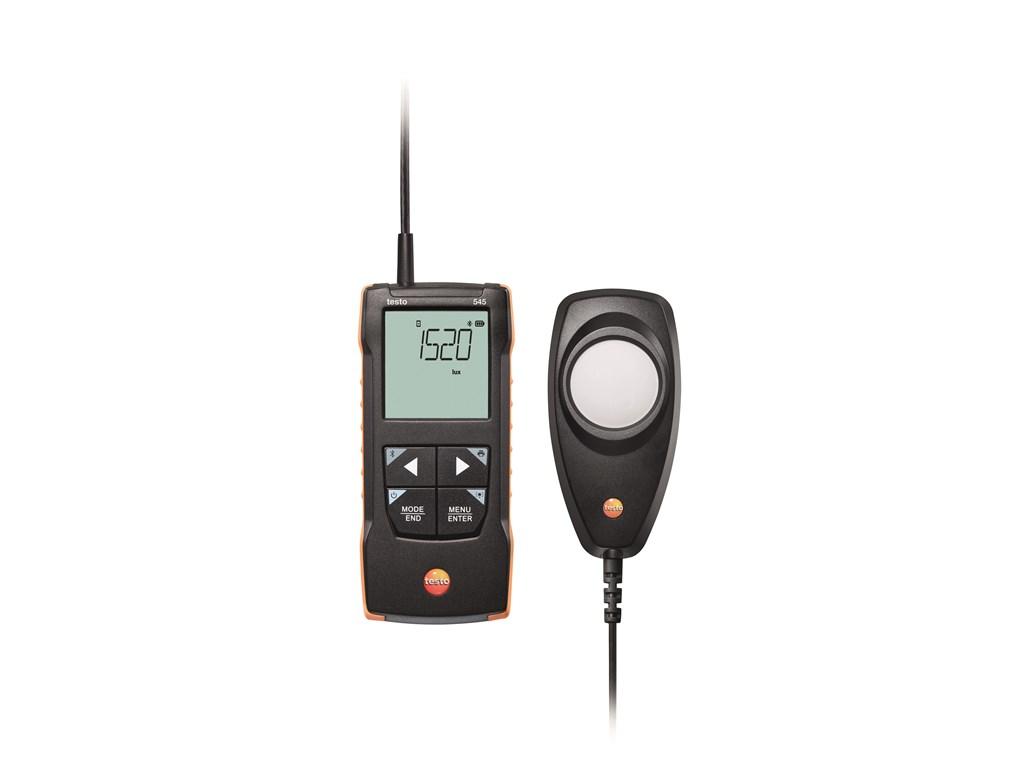
There can be several reasons to invest in a light meter. For example, if you want to focus on the company's working environment, a light meter, also known as a lux meter, can be an indispensable aid. Find the right measuring instrument for your light measurements in the selection below:


Why perform light measurements?
It may initially seem a bit odd to have to consider the present amount of light, but in fact, it can be a good idea for, among others, the business owner to keep an eye on how much light is, for example, in the workplace and thus perform light measurements.
It is indeed the case that lighting and light distribution influence factors such as performance and workplace safety. By considering the light in the workplace, you can provide your employees with the best possible working conditions, so together you can achieve the results you strive for.
At Buhl & Bønsøe, we recommend choosing a light meter with high precision when you need to consider the amount of light present in your workspaces and perform your light measurements.
What is measured in Lux?
A typical light measurement is also called an evaluative light measurement. When you need to perform such a measurement and need to get a light meter, you will often encounter the term ‘luxmeter’. This is because when you perform your light measurements, they are measured in the unit Lux.
Specifically, it works such that the illuminance (unit: lumen) between a light source and the illuminated area is measured using the unit lux (lx). The illuminance is exactly one lux when the brightness of one lumen (lm) uniformly illuminates an area of one square meter. A lux measuring instrument (light meter) is referred to as a luxmeter or a photometer.
Visible light is the part of the electromagnetic radiation (energy) that we humans can see. You can experience visible light either as different colors or as white light – this occurs when there are equal amounts of all visible colors. You can read more about this in the following section.
What do my light measurements measure?
The human eye is most sensitive to light in the middle part of the visible spectrum (a green color) and least sensitive in the two outer areas of this spectrum (violet and red light).
Measuring units for visible light are designed so that the measuring units take into account this difference in light sensitivity in the human eye. Measuring units for visible light in your light measurements are a measure of the human eye's experience of the intensity of visible light.
The measuring units for visible light do not directly tell how much energy an object is actually affected by, and the measuring units say nothing about colors. When we use the term visible light, we mean radiation within the wavelength range of 380 to about 780 nm (nanometers). 1 nm = 1/1,000,000,000 m.
Fortunately, it is far from all the technical details you need to know when you are going to perform your light measurements, but if you are still interested in reading more about how light is measured, you can visit our page on the subject. You can find it here.
When should I perform light measurements?
As mentioned, it can have a significant impact on productivity in the workplace that the light on site provides the right illumination. It is indeed the case that, in addition to parameters such as temperature, humidity, CO2, and noise, light also helps determine the indoor climate in a workplace. Here, light measurements thus become a good idea.
With light measurement, a monitoring of light conditions is created, and measuring the lux level is therefore an important part of comfort level measurement in the workplace. For this purpose, you will need a light meter (luxmeter). Light measurement indeed creates a better working climate.
Once you have determined whether more or less light is needed, you may also need to measure other parameters. At Buhl & Bønsøe, we carry numerous professional measuring instruments with high precision. Explore the complete selection here.
Find the equipment for your light measurements here
If you work as a workplace environment coordinator somewhere where employees complain of headaches or poor lighting, it is important to be able to document to management that it is the lighting that is the cause if all other possible factors have been excluded.
With, for example, a Testo 540 light meter, you can quickly measure and document light levels and temperature in the light. At Buhl & Bønsøe, you will most likely find your new luxmeter. We indeed have a good selection of measuring equipment for light measurement. If you want to know more about your next luxmeter or other equipment, read more about our measuring equipment and watch product videos on our YouTube channel.
If you are unsure which of our instruments best helps you with your light measurements, where you need it, you can always ask us for advice. We have more than 40 years of experience with professional measuring equipment, and our skilled staff is always ready with advice and guidance. Contact us, and let us find out together what we can do for you.