
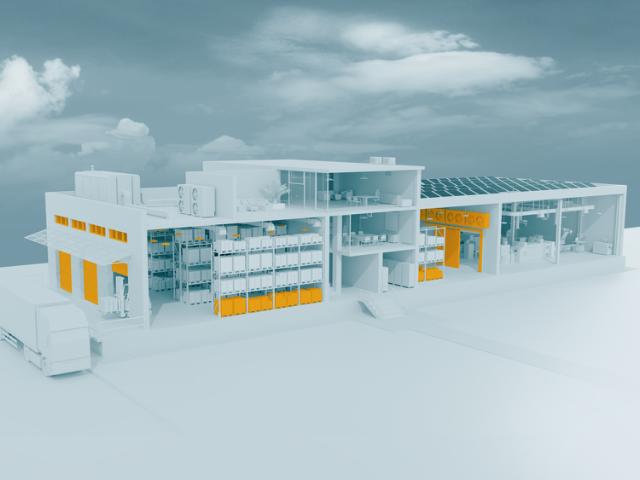
Mapping in warehouses, premises and cargo areas
Mapping in warehouses, premises and cargo areas
Temperature mapping, temperature mapping or just ‘mapping’… as we all know, it goes by many names. It’s simply about ensuring that the temperature levels in spaces stay within certain limits in different parts of the same space. You should map in both summer and winter to find out how the indoor climate is affected by hot and cold outdoor air entering the premises.
In operations with warehouses, logistics centers and transports, as well as in pharmaceutical production, it is standard to carry out and document temperature mapping. This is done to ensure that different raw materials, substances and products are stored in optimal indoor climates and do not risk deterioration due to incorrect temperature levels.
How are premises affected by summer heat and winter cold?
A survey of temperatures can be carried out in warehouses and business premises, as well as cargo areas for land, sea and air transport. As mentioned, you should carry out mapping in your premises at two different times of the year. Firstly, when it is really hot in summer and secondly when it is ideally coldest in winter. These mappings will give you a clear picture of how large differences in outdoor and indoor temperatures affect carefully specified climates in key spaces. For those with warehouses, these measurements are particularly important because warm winds and cold air blowing in when doors open and close can have a major impact on the climate of the space. The results of your mapping will show you where it is important to measure the temperature in a space, that you might want to avoid storing sensitive products there or need to package them in a particular way.
How does mapping work? Well, broadly speaking.
Preliminary study and preparation
– In order to make a reliable mapping, we always start by carefully studying all the drawings. We consider areas, volumes, shelf space design and other important parameters. Then we calculate where all the measuring points should be placed. Firstly, to ensure an evenly distributed measurement of the entire storage area. Firstly, to identify and monitor potential problem areas such as areas around windows and doors where temperatures can differ significantly from other parts of the space.
A basic document is created and sent to the customer for approval of all measurement points. All documentation is in English so that everyone in international companies and authorities can understand the information.
Measurement and mapping
Before starting the measurement, a thermography is always carried out to locate any weak points in the spaces. The results are compiled in an appendix to the final report.
To access and measure high up on shelves and pallet racks, mapping staff sometimes need a ladder or skylift in some areas. It is up to the customer to ensure that these and other facilities are in place when the mapping takes place.
Unlike other market players, Buhl & Bønsøe follows the entire measurement process online and can detect the slightest risk of deviation. We also set up logs that help refrigeration engineers to set up cold rooms correctly before mapping, thus avoiding unnecessary deviations. And if desired, we can provide you as a customer with preliminary measurement curves, so that you are also updated during the mapping process.

Examples of performing a mapping with a rented data logger system
Example 1: Mapping with one DANAK accredited input calibration
- Startup with preparation and initial calibration of the data logger system
- Installation of sensors and mapping
- Remote reading and continuous reporting of data during mapping
- Removal of loggers
- Assistance with documentation
Example 2: Mapping with DANAK accredited input and output calibration
- Startup with preparation and initial calibration of the data logger system
- Handover of the prepared system to the customer, including user instruction
- The customer performs mapping during the agreed period
- Remote reading and continuous reporting of data during mapping
- The customer returns the data logger system after completed mapping
- DANAK-accredited final calibration is performed; all certificates are forwarded
Example 3: DANAK Accredited mapping – 3 calibrations in total
- Startup with preparation and initial calibration of the data logger system
- Installation of sensors for winter mapping
- Removal of loggers after the mapping period
- Final calibration (also used as initial calibration for summer mapping)
- Reserve these loggers for summer mapping
- Preparation of DANAK-accredited report for winter mapping
- Installation of loggers and mapping for summer mapping
- Removal of loggers
- Final calibration
- Preparation of DANAK-accredited report for summer mapping
